From preparing LA Galaxy’s stage for the FIFA World Cup to building a tournament in desert
For more than two decades, LA Galaxy groundsman Shaun Ilten has worked in a profession where perfection often goes unnoticed. If the surface is flawless, players, coaches and fans rarely mention it. If something goes wrong, however, the spotlight quickly turns to the pitch.
Turf Business recently spent time with Ilten to discuss the demands of maintaining elite-level football surfaces in one of the world’s most high-profile sporting environments, and how consistency, communication and attention to detail have shaped his approach across a career that now finds him at the centre of preparations for the FIFA World Cup.
As Senior Director of Turf & Grounds at Dignity Health Sports Park in California, Ilten is responsible not only for the stadium pitch itself but for the wider training environment used by LA Galaxy. Every surface players interact with falls under his remit, from the main field to surrounding practice areas, and that consistency becomes even more important with the arrival of international football. With the FIFA World Cup heading to the United States (11 June 2026 – 19 July 2026), the stadium has been selected as a designated training venue for teams playing matches at SoFi Stadium, meaning Ilten’s work will soon be scrutinised by FIFA, international coaching staff and some of the world’s best players at the most important tournament in football.
Preparing for the FIFA World Cup
“We are a site-specific training ground for SoFi Stadium,” Ilten explains. “So all the teams that play there during the World Cup will train here on our stadium field, match day minus two, match day minus one, depending on their schedule.” In practical terms, that means the stadium becomes a focused preparation base rather than a match venue, with teams arriving for short, highly specific training windows in the final days before their games. Paraguay, Iran and Switzerland are among the nations expected, with others still to be confirmed, and Ilten believes as many as eight teams could ultimately pass through depending on how tournament logistics unfold.
Despite the scale of the event, Ilten remains calm about what lies ahead. The movement of teams, security protocols and scheduling complexities are largely outside his control, yet once the squads arrive on site his focus returns to familiar ground. “It all depends on where their base is, whether they want to fly in early, or whether they’re just going to come in the day before the game and play,” he says, describing a process that, while globally significant, still ultimately comes down to pitch readiness and timing.
For many in his position, a World Cup would represent a career-defining moment of pressure, but Ilten’s approach is grounded in repetition rather than nerves. There is acknowledgement of scrutiny from FIFA and visiting federations, but it is tempered by decades of routine. “It’s a little bit of both,” he says when asked about pressure. “Some aspects are a little nerve-wracking because you have FIFA coming in and looking at what you do, but at the same time it’s just another day. It’s doing what I’ve done for the last 21 years, providing a quality pitch for whichever team comes and plays here.” That mindset reflects a philosophy built on consistency, where standards are maintained through process rather than emotion.
FIFA’s requirements have not forced any radical change to his methods. Instead, preparation has focused on refining existing systems following the MLS season, with the pitch entering a controlled maintenance phase after the fixture on May 2 and ahead of the next home match on May 23. Work during this window has included unit raking, aeration, overseeding and topdressing to return the surface to the standards required for international football.
Even with the World Cup approaching, there is no plan to expand staffing or bring in external contractors. Ilten is clear that the existing team will handle everything. “We’ll handle it all in house. We won’t ramp up any new employees. We’re going to keep it with what we have,” he says. That confidence is rooted in familiarity, with a team that already understands the expectations of elite-level football and the standards required at international level.
There is, however, an awareness that opportunities like this are rare, and Ilten is candid about the significance of the tournament in his career. “It’s exciting,” he admits. “It’s something a lot of groundsmen look forward to but not many will ever experience. So I’m going to take it all in my stride and just live in the moment because it’s probably something I’ll never see again.” Alongside the pressure and preparation, there is also a sense of professional exchange, with Ilten valuing the opportunity to observe and learn from visiting international staff while also sharing his own methods. “It’s something I’ve always relished,” he says. “Having people come over, giving me their perspective and taking little bits and pieces of what they do and incorporate it into what we already do.”
Building the Coachella Valley Invitational
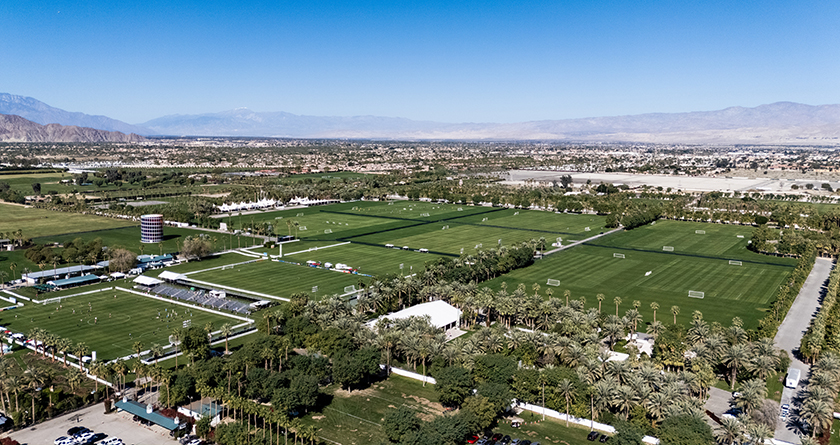
While the World Cup is the immediate focus, one of Ilten’s most demanding and unusual projects sits in the Californian desert. The Coachella Valley Invitational, staged on the same grounds that host the Coachella and Stagecoach festivals, has evolved into a major pre-season hub for MLS and now women’s football. The site itself is a festival landscape for most of the year, and transforming it into professional football pitches requires significant planning and intervention.
Ilten recalls his first visit to the site with scepticism. “I drove two and a half hours out there,” he says. “There was no way we were going to host a pre-season tournament out there with professional athletes.” The land had previously been used for polo, with horses having churned up the surfaces, and large-scale music festival infrastructure had left behind deep structural issues. Concert delay towers required excavation, often eight feet deep, and when removed were rarely backfilled to a standard suitable for elite sport. “They dig down eight feet,” Ilten explains, “but when they backfill, they don’t do it correctly because they know next year we’re just going to dig here again.” The result was a playing surface with hidden inconsistencies that posed genuine injury risks beneath otherwise playable turf.
Despite those challenges, the project moved forward. In the first year, only five teams participated, allowing Ilten to identify usable areas and construct ten pitches, including a main match field. The work was manual and intensive at first, with fields measured and marked by hand before technology such as the Turf Tank robot streamlined the process. “I said, ‘I’m not doing this if we’ve got to build 23 fields,’” he laughs. “So we enlisted the help of what I call my best employee, the Turf Tank.”
From there, the tournament expanded rapidly. Five teams became ten, then thirteen, eventually growing into 26 training pitches and three match fields. Temporary stands were added, allowing fans to attend and watch pre-season matches at close range. “It’s phenomenal for soccer fans because they can get so close to their favourite teams,” Ilten enthuses, but as the scale increased, so too did the agronomic demands. Last year alone, around $50,000 worth of sand was applied to level surfaces before laser grading ensured consistency across the playing areas. Every pitch needs to be closely inspected with safety always the priority. “I don’t want somebody’s star player to go out there and blow an ACL or break an ankle,” he says. “Safety is my number one.”
Once the Major League Soccer (MLS) competition finishes, the site does not stand idle. A second wave of teams arrives almost immediately, with nine National Women’s Soccer League (NWSL) sides using the same facilities for a week of preparation before their season begins. It is a back-to-back schedule that highlights how heavily the venue is now relied upon as a shared elite training environment across both men’s and women’s football.
The surfaces themselves are carefully managed to cope with extreme desert conditions. Bermuda grass forms the base due to its heat tolerance, while perennial ryegrass is overseeded during cooler months to maintain colour, density and playability. By tournament time, fields are typically 80 to 90 per cent ryegrass, although weather can shift that balance. Expansion remains limited by irrigation infrastructure, with much of the surrounding land relying on overhead systems rather than underground watering. “We could build another 50 fields out there,” Ilten says, “but there’s no underground irrigation.”
Balancing MLS Demands with a Global Tournament
Looking ahead, planning never really stops. Preparations for future desert tournaments are already being discussed while the immediate focus remains on balancing MLS responsibilities with World Cup demands. There is little recovery time between competitions, and Ilten accepts that as part of the job. “They’re not giving us much of a break,” he jokes. But after 21 years in the industry, that rhythm is exactly what he is used to, continuing to deliver surfaces for some of the biggest stages in world football.
But for now, attention narrows to the months ahead, with the FIFA 2026 World Cup set to begin on June 11. For Ilten, the tournament represents far more than a date on the global football calendar; it is the culmination of years spent maintaining standards in an environment where expectations never drop, regardless of the occasion. International teams, FIFA officials and some of the biggest names in world football will soon walk onto surfaces prepared under his direction, placing Dignity Health Sports Park firmly within the spotlight of the world game. Yet despite the scale of what lies ahead, Ilten’s approach remains unchanged: prepare the surface properly, trust the work that has gone in behind the scenes, and ensure every team arrives to conditions worthy of the occasion.