Artificial Surfaces – Are They Really Low Maintenance?
 |
While the low maintenance requirements of synthetic sports surfaces have always been one of their strongest selling points, it has become clear that planned, proactive maintenance programmes are the best way to maximise return on investment and minimise the life cycle cost.
It is a false economy to scrimp on maintenance. Whilst you may save money in the short term by extending maintenance intervals or waiting until problems occur, an expensive recovery operation or total renewal will be needed far sooner.
 |
Although suppliers and installers of synthetic surfaces opinions generally differ over which system is best for their clients, there is at least agreement from all parties on the fundamental aspects involved in the maintenance of the surfaces once they have been fitted.
Any playing surface which contains an infill, will at some stage, suffer migration of that infill away from the areas which are used most often. The intensity will vary dependent on the usage and the particular system used, but rest assured, it will happen nonetheless.
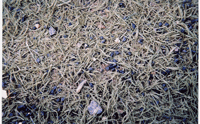 |
Dirt and debris will accumulate on the playing surface which may have been brought on by the wind and rain, the player’s footwear, or if an indoor facility is being used, general dirt and dust from within the building.
If left untreated, the surface will gradually deteriorate.
Degradation of the synthetic carpet fibres and infill (whether using rubber and/or sand) will occur. The severity of this will depend on the system being used and the quality of materials used during the installation of the carpet. However, through general play and exposure to the natural elements of the weather, there will be some loss of integrity.
With no maintenance programme in place to counter these issues, the playing surface will eventually become contaminated. This will not only affect the performance of the surface but also the general health and safety of the surface. It is therefore imperative that an appropriate maintenance programme is introduced as early as possible from the installation date.
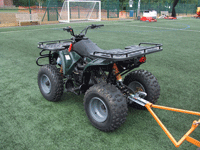 |
Drag Brushing is now considered to be a fundamental part of any maintenance programme. Various recommendations exist on what machinery should be used for this process, which can include the use of static/oscillating brushes or drag mats fitted to a suitable vehicle. Whatever method is preferred, it is important that the process should ensure that the infill is kept evenly spread and the pile is kept erect. The frequency will depend on a number of factors i.e amount of usage, sport being played etc but should be carried out at least on a weekly basis.
Power sweeping actually removes the contamination from the surface which drag brushing alone will not. Using the correct brush textures means the rotary action removes contamination through a series of sieves, hopper and vacuum whilst at the same time lifting the pile of the carpet. This process should be only used to complement a drag brushing programme and carried out as part of an on-going programme. Depending on how often the surface is being drag brushed; a monthly, bi-monthly or quarterly regime should be put into process.
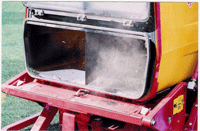
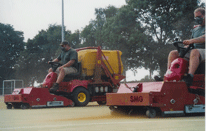
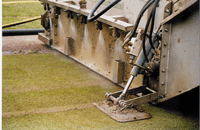
Revite® is a specialised process which should be carried out on an annual or bi-annual basis. This process is far more intense and penetrates much deeper into the pile than the other methods described. This allows the removal of the finer dust and debris and opens up the pile which would otherwise slowly begin to close off causing hardening and ultimately give users drainage problems. Dependent on the scale of the contamination, the process can take anywhere from one to five days to complete successfully.
 |
So to close, synthetic surfaces, whilst being able to be played on in all weather conditions are not ‘maintenance free’ as some people would have you believe – like all playing surfaces, they require a regimented maintenance programme to be able to perform at their best.
Technical Surfaces’ use their experience from the past ten years to educate clients on the correct maintenance requirements. Given this vast amount of knowledge it is hardly surprising that Technical Surfaces is now considered the leading synthetic sports pitch maintenance specialist in the UK. Their client base spans the length and breadth of the country and includes large local authorities as well as small clubs and private court owners.
Technical Surfaces run training courses all over the country. For further information, please call 08702 400700 or visit www.technicalsurfaces.co.uk