Turf BusinessTurf Business
  • Home
  • News
  • TB TV
  • Magazine
  • Podcast
  • Media Info
  • Summit
  • Contact
  • Subscribe
  • Turf Business Facebook
  • Turf Business Twitter
  • Turf Business Instagram
  • Home
  • News
  • TB TV
  • Magazine
  • Podcast
  • Media Info
  • Summit
  • Contact
  • Subscribe
  • Turf Business Facebook
  • Turf Business Twitter
  • Turf Business Instagram

Cut Your Carbon Footprint

27 Aug 2007

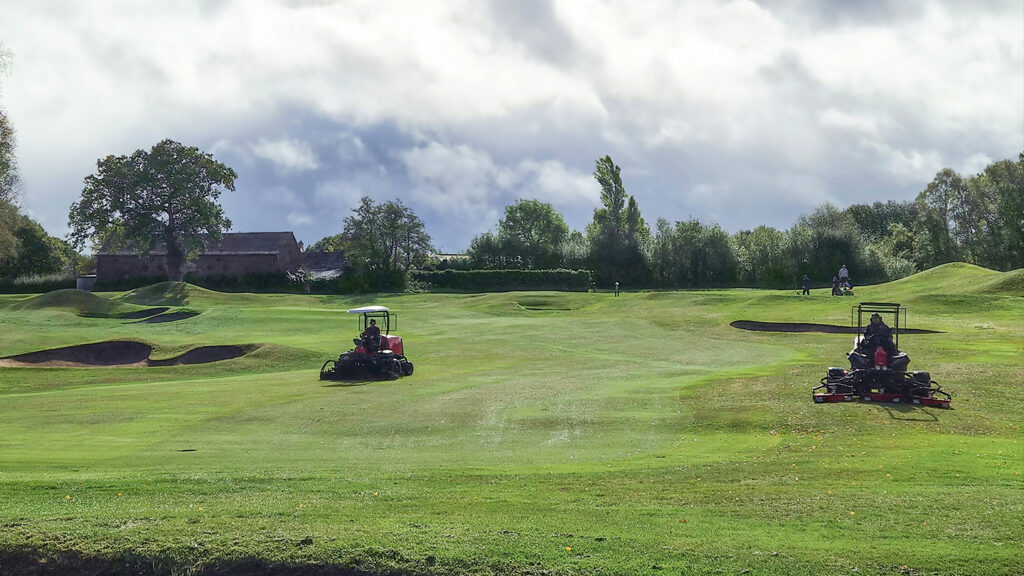
Every morning exhaust fumes envelope grounds maintenance yards as mowing teams’ fire up for the daily battle with grass growth. The cost in machinery and fuel adds up to thousands of pounds a year, but there is also the implication to the environment of the continual mowing operation.

Increasingly turf managers are finding regulating grass growth can not only improve turf quality, but the savings in time and costs can also help to cut the carbon footprint and environmental impact.

On golf courses, greenkeepers frequently find that mowing intervals on Primo MAXX treated fairways can be extended by 30% or more, and up to 50% on semi-rough areas. Even greens can be left uncut for a day with minimal loss in playing surface speed – which can be especially useful in letting turf recover after periods of heavy play or stress.

Save Costs
For amenity turf maintenance, including roadside verges, parks and sports fields, mowing regimes can typically be cut by up to 50% with turf in Primo MAXX programmes, with equivalent savings in costs and carbon emissions. Furthermore, for local authorities extending cutting interval reduces disruption to road traffic during mowing operations and nuisance noise levels from strimmer or brushcutter use in urban areas.

Experience has also shown Primo MAXX programmes can reduce the volume of grass clippings by up to 60% – significantly reducing volumes for composting or mulching.

Better Results
Microbial activity during the composting oxidation process releases carbon dioxide back into the atmosphere. Grass cut and mulched also releases CO2  as it decomposes. The short cycle means virtually
100% of the CO2 locked up during growth is released during decomposition.

Furthermore, grass clippings are difficult to compost alone, since they tend to be highly nitrogenous and distort the compost’s carbon:nitrogen balance; which ideally should be around 30:1. Reducing the volume of grass in a compost mix could help to achieve a better result, with less CO2 released.

Related Posts

Top Brands Return for SALTEX’s 80th Year

eNews Slot 1, Featured, News

Top Brands Return for SALTEX’s 80th Year

Jeremy Vincent joins Advanced Turf Technology

eNews Slot 2, Featured, News

Jeremy Vincent joins Advanced Turf Technology

ST Enodoc takes a joined up approach witH Toro

eNews Slot 3, Featured, News

ST Enodoc takes a joined up approach witH Toro

  • Contact us
  • Privacy Policy
Turf Business
© TurfBusiness 2025. All Rights Reserved.
Tigerfish - Build | Promote | Succeed
This website uses cookies to improve your experience. We'll assume you're ok with this, but you can opt-out if you wish.No Problem Reject Learn More
Privacy & Cookies Policy

Privacy Overview

This website uses cookies to improve your experience while you navigate through the website. Out of these, the cookies that are categorized as necessary are stored on your browser as they are essential for the working of basic functionalities of the website. We also use third-party cookies that help us analyze and understand how you use this website. These cookies will be stored in your browser only with your consent. You also have the option to opt-out of these cookies. But opting out of some of these cookies may affect your browsing experience.
Necessary
Always Enabled
Necessary cookies are absolutely essential for the website to function properly. This category only includes cookies that ensures basic functionalities and security features of the website. These cookies do not store any personal information.
Non-necessary
Any cookies that may not be particularly necessary for the website to function and is used specifically to collect user personal data via analytics, ads, other embedded contents are termed as non-necessary cookies. It is mandatory to procure user consent prior to running these cookies on your website.
SAVE & ACCEPT
MENU
  • Home
  • News
  • TB TV
  • Magazine
  • Podcast
  • Media Info
  • Summit
  • Contact
  • Subscribe
  • Turf Business Facebook
  • Turf Business Twitter
  • Turf Business Instagram