How Briggs & Stratton is changing the angle on slope mowing
Bringing together two of Briggs & Stratton’s core commercial entities, Vanguard and Ferris have partnered to provide integrated solutions for the professional turf care sector, effectively uniting two branches of the business that are inherently designed to work as one. Vanguard, Briggs & Stratton’s brand for commercial power solutions, is focused on supplying high-performance engines and battery solutions to professional and industrial trades across the globe. Working with Ferris, Briggs & Stratton’s premium lawn mower provider with pioneering patented suspension technology, the two organisations have come together to overcome power related obstacles faced by those in the professional turf care industry.
Traditional mowing equipment has been designed primarily for flat areas or gentle slopes, but on steep inclines and rough terrain, there are risks associated with these machines. More extreme conditions push machines beyond their limits, leading to excessive wear, higher fuel consumption, and increased emissions. Innovations such as autonomous and remote-control lawnmowers that can help to tackle these issues whilst also prioritising comfort, safety and ease of use are significantly important.
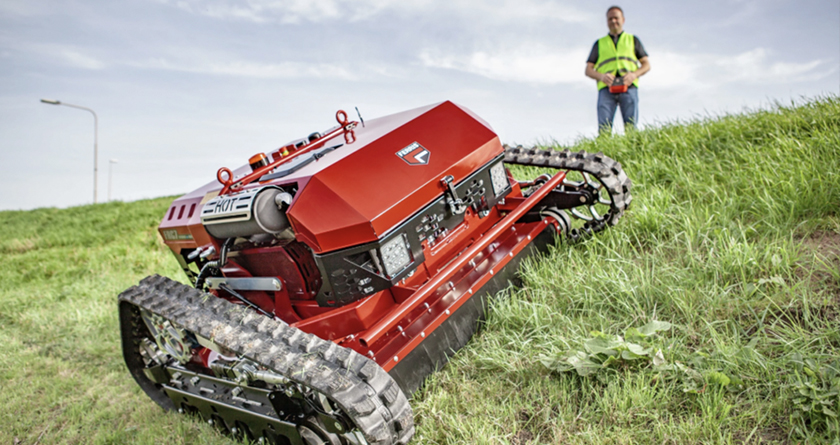
One of the machines that has been developed to tackle problems facing the turf industry is the Ferris FRC7. The Ferris FRC7 is a remote-control hybrid slope mower that is designed to face the toughest conditions with quality and precision. This is all achieved whilst being compact and easy to store.
In the design phase, Ferris needed an engine system which was capable of providing the necessary power to combat challenging slopes, whilst being durable, reliable and small enough to fit within the machine’s limited space. The selected engine also had to communicate via CAN-bus, allowing all components of the mower to work seamlessly together.
To this end, the FRC7 utilises the 17,2kW EFI horizontal shaft engine from Vanguard. This engine was selected for its seamless integration and ideal size, as well as its upward-facing cylinder orientation. This prevents inefficiencies caused by the pistons working against the oil column in the engine sump when operating at extreme inclination angles which allows for reduced downtime, lower maintenance and, as a result, allows the machine to have more reliable performance.
At the heart of the machine is a mild hybrid drive system, where two power sources—combustion and electric—work in tandem to enhance performance. A generator charges a 48-volt battery bank that acts as the main energy buffer for the mower’s electric drive system.
In addition, Vanguard’s Electronic Fuel Injection (EFI) system enhances engine performance by improving efficiency, reducing fuel consumption and minimising emissions. Managed by the CAN-bus controller, the Vanguard 17,2kW horizontal shaft engine seamlessly integrates into the sophisticated communication network that facilitates real-time data exchange between the various components of the mower to ensure highly dynamic and efficient operation.
Sjoerd van de Velde, Managing Director at Briggs & Stratton EMEA, says: “The Vanguard 17,2kW horizontal shaft engine is a reliable and powerful product and combining this with Ferris’ cutting-edge mower created the perfect solution to the issues turf care professionals face around difficult terrain. This product is already positively impacting landscapers and represents the future of slope mowing.”
The Vanguard 17,2kW engine enables the Ferris FRC7 to effectively combat tough slopes and terrains whilst operating with quality and precision. Using the advantages of CAN-bus and Electronic Fuel Control (EFI),, the Ferris FRC7 guarantees strength and reliability for turf care professionals even when faced with the most challenging conditions.
For more information on Vanguard power solutions please visit: https://www.vanguardpower.com