Treating Winter Ailments
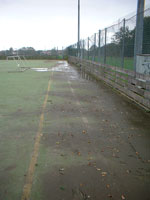 |
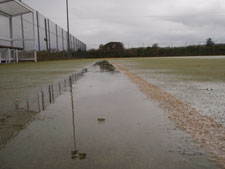
Rain, drizzle, frost and fog – the effects of the Great British winter can take their toll on synthetic sports surfaces, leaving behind a trail of standing water, surface silt and health & safety risks. What’s more, recent poor summers have done little to ease the pressure on artificial pitches and courts, which as ‘all-weather’ facilities must be in peak condition all-year round, to meet the ever-growing demand for sport and leisure activities.
Every year, growing numbers of pitch managers are being forced to cancel fixtures during the winter months, discovering that their synthetic surfaces are insufficiently prepared to withstand both the increased rainfall and the resultant mud and sludge being trafficked onto the pitch by users. Cancellations in winter soon creates a downward spiral of lost revenue, from which it can be hard to recover – in these circumstances, spending time and money on maintenance is often rejected in favour of accruing some much-needed income as the weather begins to improve. However, continually postponing maintenance until such time as a synthetic surface can no longer function without urgent remedial works is nothing short of a false economy, leading to a reduced life expectancy and even higher maintenance costs. And all it takes is a few bad summers, coupled with longer, harsher winters, for a neglected surface to deteriorate further and faster…
If this all sounds familiar then don’t panic. Technical Surfaces, the UK’s leading synthetic sports surface maintenance specialists, are here to help steer you through the festive season.
Whether your facility needs a Winter Revival™ to deal with surface mud and sludge, repairs to fix any failed seams or inlaid lines weakened by the colder climate, salt to help prevent your synthetic facility from freezing and becoming unplayable over the winter period, or a complete Rejeneration® to remove the deeper contamination that causes standing water, Technical Surfaces can help.
 |
 |
Their unrivalled knowledge of maintaining synthetic sports surfaces has helped them to identify common issues particularly prevalent during the autumn and winter months. “An absence of appropriate maintenance will over time lead to a build-up of contaminants in the carpet infill,” explains Nick Harris, UK Sales Manager at Technical Surfaces. “This will not only affect the playing characteristics of the surface but can also cause problems with pitch drainage. For example, during periods of heavy rain you may notice that tide marks or silt areas appear on your surface. This will have been caused by rainwater backing up and flushing out the contaminants from the infill, depositing it onto the surface as it slowly drains away.” If left unattended to, such material is likely to pose an ongoing health and safety issue for the users of the surface.
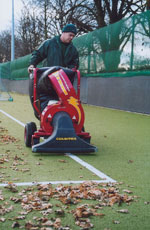
A Winter Revival™ will allow for the removal of this material to help restore the aesthetic qualities of your facility and provide an interim solution. However, the Winter Revival™ is essentially a short-term, cosmetic process, designed to keep a facility open where it would otherwise be forced to close; it will not necessarily address the core issues of the problem. Indeed, the presence of this material should be regarded as a symptom of the problems the surface is experiencing, and in cases where the drainage has become seriously compromised Technical Surfaces always advise their customers that consideration is given towards a deep-cleaning Rejeneration® to fully remedy the underlying causes of poor drainage, surface silt and infill contamination.
 |
Nick Harris goes on to say: “This time of year always sees an increase in the number of calls we receive for repairs to pitches. The first sign of frost and any weakness in the seams of a surface are exposed as the water on the surface expands and in effect ‘blows’ open the joints”. Technical Surfaces operate an emergency repair call out for its clients, with a fleet of over 20 maintenance vehicles operating across the UK every day, it can normally attend to such issues with 24 hours helping to keep clients pitches open.
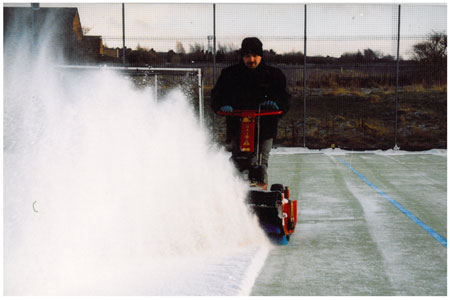
As well as causing problems with seams and joints, frost can in severe cases close down a pitch completely. Each year Technical Surfaces receive requests from clients wanting advice on how best to ‘de-frost’ their frozen surface. Technical Surfaces has researched the application of various different substances in an effort to find the best solution. “Rock salt and grit should be avoided at all costs, as these could lead to contamination of the surface” says Nick. “Trials have shown that an even spread of Vacuum-Dried Salt across the surface can help prevent the carpet from freezing as it will dissolve, leaving no impurities in the surface. However, we always advise our clients that the benefits are very varied in different weather conditions, and the salt should be used to help prevent freezing rather than used as a defrosting agent. The results and longevity of this substance can vary from site to site and in differing weather conditions, so unfortunately we do not offer any guarantees to the success of using such a product.”
It is estimated that an initial treatment of approximately 1 tonne of salt for a full-size surface or 125kgs for a five-a-side kick-about facility will provide a sufficient protection during a few days of cold weather, although this will depend on the intensity of any rainfall, frosts and snow that may occur over the period and its overall impact on the facility in question.
 |
While there are processes specifically designed to combat the effects of a cold, damp climate on the playability of synthetic sports surfaces, Technical Surfaces are keen to stress the underlying point that maintenance is not just a once-a-year requirement; the vast majority of procedures can (and should) be completed year-round. Indeed, if greater emphasis is placed on preventative maintenance while weather conditions are more forgiving, you may just find that less corrective work is required when the cold creeps in.
In line with their company ethos, ‘Maintaining Standards’, Technical Surfaces are the UK’s number one synthetic maintenance specialists and can also recommend and design regular preventative maintenance programmes, helping to stop such problems from developing in t
he first place.
So, whilst it may be tempting just to ‘muddle through’ the winter months, with good intentions of getting around to sorting out that persistent standing water when the weather improves, don’t forget: the British climate offers no guarantees, and surface issues are often symptomatic of deeper-seated problems, which will only worsen if ignored. Instead, let the experts get your synthetic sports surface through the winter and beyond, giving you an all-weather facility that really can cope in all weathers.
For more information on implementing the right maintenance programme for your synthetic sports surface, visit www.technicalsurfaces.co.uk or call their National Office and speak to a Technical Manager on 08702 400 700.