Driven by innovation, powered by John Deere
How this year’s Solheim Cup made its mark as the most sustainable yet
Written by Abi Moss-Coomes
The Solheim cup returned on 7-13th September, for the 20th edition of this biannual Europe VS USA golfing event. 2026 saw The Netherlands host the event for the first time, with the stage being set at the world-class Bernardus Golf.
Turf Business visited Bernardus one month out of the tournament to see how the course was being prepared for the biggest team tournament in women’s golf.
After cycling to the venue, as part of the event’s sustainability efforts, first impressions were impressive. The course was empty, being rested after a tough summer that saw four heatwaves reaching highs of 40 degrees.
Unfortunately, the challenging weather in the run up to the Solheim Cup did not stop once the tournament began. The Sunday of the event was met with heavy downpours, but the greenkeeping team have received praise for the way the course played despite the heavy rain.
So, as Team Europe celebrate their victory in the 2026 Solheim Cup and Bernardus Golf recovers from the 80,000 spectators that attended across the event. Turf Business reflects on the visit that showed the calm before the storm.
Bernardus Golf has raised to golfing prestige quickly, for a course that only began construction in 2017, it has already hosted three Dutch Open’s on the DP World Tour, and now the Solheim Cup.
The 18-hole Championship Course, designed by Kyle Phillips, is renowned for its environmentally conscious approach to golf, making it the perfect home for the most sustainable Solheim Cup to date. And creating the perfect partnership with John Deere, an official golf course and turf maintenance machinery partner.
Setting the standard for sustainability
The 2026 Solheim cup set their sights on being the most sustainable event to date, hoping to set a benchmark for sustainable sporting events. This includes, low emission mobility, renewable energy and local and organic farming, amongst other initiatives. But low emission mobility doesn’t only apply on the way into the event. No general parking and cycling schemes may have been put in place for spectators, but on the course, John Deere is taking care of the low emission transport across the event, with their TE/ GS Electric Gators making up just part of the low emission machinery fleet supporting this year’s Solheim Cup.
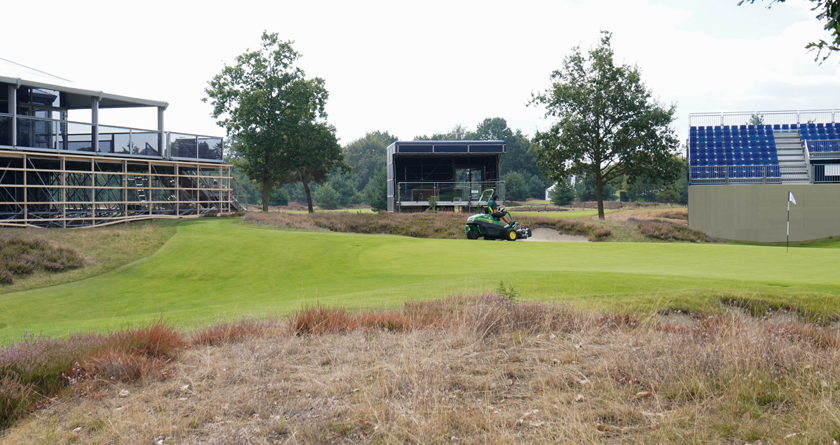
Made up entirely of electric or hybrid powered solutions, John Deere are supplying the tournament fleet that will be used by the nearly 90 strong greenkeeping staff across the event- a step up from the usual 18 day to day staff that work the Bernardus. Supporting the process is local supplier Kraakman. Although supplying for a large number of tournament events, John Deere chooses not to have a ‘standard’ tournament fleet, instead preferring to tailor each fleet to the demand of the event. In this case, that includes electric bunker rakes, electric gators, hybrid fairway mowers, electric greens mowers and electric walk-behind greens mower. Both John Deere and Bernardus Golf are in agreement that it isn’t simply supplying equipment for the tournament, it’s about knowing the equipment will work for the course in the long term.
Niall Richardson, Golf Course Superintendent, puts sustainability at the forefront of his work at the course. Construction of the course began in 2017, designed by Kyle Philips, with Naill playing a role in the development of the project from the beginning. The idea was the develop a course that fit seamlessly into nature. Less water, less chemistry, less emissions. Across the 82-hector site, only 33 hectors is maintained sports surface, the rest is left to nature, and those maintained 33 hectors were designed from the offset to promote sustainability. The 100% fescue course requires less water and nutrition than other grass strains, a consideration that Niall and the team took very seriously when planning the construction of the course. Not only the nutrition and water element, but the slow growth rate was also a pulling factor as the reduced cutting directly cuts emission rates.
The Solheim Cup deal is not the first time John Deere will play a part in the maintenance of Bernardus Golf, as Naill was already in the process of switching to John Deere for their everyday maintenance fleet. The decision, he said, was swayed significantly by feeling heard has a customer and professional user. Being involved in research and development meetings meant that he felt taken seriously and is already looking forward to future John Deere developments that meet the needs he’s raised in these meetings. Another significant pull that influenced the transition to John Deere was the satellite guided sprayers, with a GPS sprayer being the first piece of John Deere kit within the machinery transition. On an already eco conscious course, the chance to significantly increase spraying accuracy through GPS usage was something that appealed to Niall. He comments on the 20% saving he has already made on product, being able to accurately pinpoint and spray selected areas.
The John Deere Operations Centre plays an important role in the management of the golf course. Naill discusses the importance of data collection within sustainability efforts, highlighting the significant reduction in water and product usage now data can accurately measure and highlight the areas that require it. ‘Naill describes the process as “Using smart technology to make smart decisions”. The John Deere Operations Centre has grown significantly over the last few years, from the turfcare industry having just 228 machines connected in 2022 to 7000 in 2026. The system feeds data back to one centralised system, increasing user safety, monitoring fleet management and predicting weather patterns. It’s a comprehensive management tool that Naill values, especially during the intense period in the run up to the Solheim Cup.
John Deere may be a name that’s more commonly associated with agriculture, but Chris Meakcock, Golf & Turf Sales Manager for John Deere, reminds us that they have been working within sports turf for nearing 50 years. They use their experience within the agricultural industry to bring innovation to the sports turf market. Using the autonomous sprayer as an example, Chris explains that it’s a product that has been readily used within agriculture and is now being adapted to work on a smaller scale on sports surfaces. While John Deere acknowledge that they may not be seen as first to the market with new products, noting the lack of autonomous machines in their product line up, they pride themselves on bringing products that are backed by the research and experience of their extensive experience of producing machinery.
The same goes for electrifying their product range, Chris remarks that putting a battery in a product simply is not enough. The product must operate to the same level as existing products, working and feeling exactly the same, with a focus on the safety and productivity of the users.
Together John Deere, The Solheim Cup and Bernardus Golf are shining a light and setting the standard for sustainability in sport. And although the Solheim Cup may have come to a close for 2026 the sustainability promise from all those involved is something that will continue in to 2027 and beyond.